
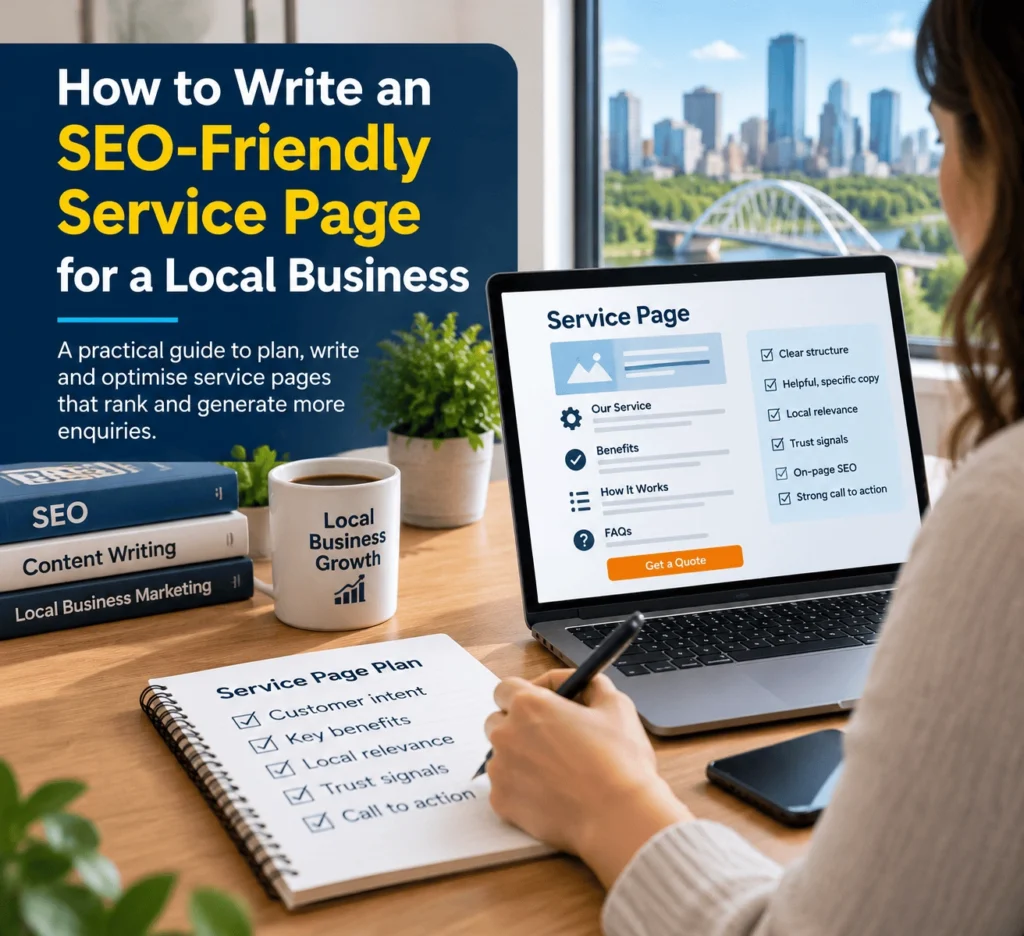
How to Write an SEO-Friendly Service Page for a Local Business
A service page can list everything a business offers and still leave visitors unsure whether the service is right for them. Effective service-page content does more than mention keywords. It matches the visitor’s search intent, explains the service in practical terms, builds confidence with genuine evidence, and makes the next step easy.
For example, a homeowner searching for a plumber may need to know which problems the company handles, whether it serves their area, what happens after they call, and how to request help. Repeating “plumber in Edmonton” will not answer those questions.
This guide explains how to research, structure, write, optimise, and review a local business service page. The examples are illustrative and hypothetical, not claims about RankUpFaster clients or results.
Research the Service and Customer Intent
Good service-page writing starts before the first paragraph. First, understand what the business actually provides, who it serves, what customers are trying to solve, and what information they need before making contact.
Identify the Specific Service
Decide whether the page is about one defined service, a closely related group of services, or a broad service category. A page about furnace repair, for example, should focus on diagnosing and repairing furnace problems. It should not attempt to cover every HVAC service in equal detail.
Separate pages can make sense when services have different customer needs, processes, search intent, or useful information. Do not create a new page for every small wording variation if the underlying service and visitor need are essentially the same.
Understand the Target Audience and Customer Problem
Write down who is likely to use the service and what matters to them. A business owner considering website content writing may care about clear messaging, brand voice, search visibility, lead quality, industry knowledge, review rounds, and the information needed to begin.
Use customer calls, enquiry forms, sales conversations, reviews, and support questions to find the language people naturally use. These sources often reveal practical concerns that keyword tools alone will not show.
Identify Search Intent and Relevant Queries
Review search results for the main service phrase and related searches. Compare informational queries, such as “how does furnace maintenance work?”, with service-seeking queries, such as “furnace repair in Edmonton”. They may need different page types.
Useful research sources include Google Search Console, keyword research tools, competitor pages, customer questions, and search suggestions. Treat keyword data as evidence to consider, not an instruction to create a separate page for every phrase.
Review Competitor Pages Without Copying Them
Review a small set of relevant competing pages to understand what customers are likely to expect: service scope, process, pricing factors, credentials, FAQs, service areas, and contact options. Note unanswered questions or confusing explanations that your page can improve.
Do not copy competitors’ paragraphs, distinctive headings, or page structures. Competitor research should help you find gaps and add original value, not produce a close imitation.
Prepare a Short Research Brief
- Main service: the exact service the page explains.
- Target customer: who the service is intended for.
- Customer problem: what the visitor wants to resolve.
- Search intent: what the searcher expects to find.
- Relevant queries: the primary phrase and useful related language.
- Key questions: what customers ask before buying.
- Genuine differentiators: real reasons the business may be a good fit.
- Conversion action: the next step the page should encourage.
Build a Clear Service Page Structure
A logical website content structure helps people find answers without forcing them to read every word. It also makes the page topic and relationships between sections easier to understand. Adapt the order to the service rather than following a rigid formula.
Write a Specific H1
Use one clear main heading that accurately describes the page. A hypothetical example is Website Content Writing Services in Edmonton. This tells visitors what the business offers and the location it serves, without squeezing every keyword variation into the heading.
Write an Introduction That Explains the Service and Audience
The opening should quickly explain what the business does, who it helps, what problem it addresses, and why a visitor should continue.
Vague example: “We provide high-quality solutions for all your content needs. Our professional team is dedicated to excellence.”
More useful hypothetical example: “We write service pages for Edmonton businesses that need to explain their offers clearly. Each page is planned around customer questions, relevant search intent, and a clear path to enquire.”
The second version gives readers a clearer picture of the service. Only use statements that accurately describe what the business delivers.
Explain Benefits and the Service Process
Deliverables tell people what they receive; benefits explain why those deliverables may matter. Instead of only saying “service-page copywriting”, describe relevant outputs such as organised page copy, clear headings, answers to common questions, and a visible enquiry path, if those items are genuinely included.
Explain the process in plain language. Depending on the business, it might include discovery, research, a draft, client review, revisions, and implementation. Be clear about what is included and what happens outside the agreed scope.
Add Proof and Credentials
Relevant work samples, verifiable qualifications, genuine testimonials, case studies, licences, or memberships can help visitors assess the business. Choose proof that fits the service. Do not invent evidence or imply that every business must display every type of credential.
Include FAQs Where They Help
Answer real questions that remain after the main copy. Depending on the service, useful questions may include:
- What does the service include?
- Who is the service suitable for?
- What information is needed to get started?
- What happens after an enquiry?
- Which areas does the business serve?
- What factors affect the price or timing?
FAQs should resolve uncertainty, not add length for its own sake. Including FAQs or structured data does not guarantee enhanced search results.
Add a Clear Call to Action
Tell visitors what to do next. For example: Request a Website Content Quote is more specific than “Learn More” when a visitor is ready to discuss a project. A lower-commitment action, such as viewing work samples, may be more suitable earlier in the decision process.
| Page element | Purpose | Common mistake |
|---|---|---|
| H1 and introduction | Clarify the service and audience | Generic claims that could fit any company |
| Benefits and scope | Explain what customers receive | Listing deliverables without context |
| Process | Set expectations | Leaving the next steps unclear |
| Proof | Support trust with evidence | Unsupported claims or invented testimonials |
| FAQs | Resolve remaining questions | Repeating keywords without adding answers |
| Call to action | Make the next step obvious | Vague or hard-to-find contact options |
Write Helpful, Specific Service Page Copy
Customer-focused website copy explains the actual service and its practical value. Broad phrases such as “best quality”, “professional service”, or “customer satisfaction guaranteed” are weak when they are not supported by specific details.
Explain What the Service Includes
Describe the relevant deliverables, scope, process, limitations, and expectations. A roofing company might explain whether an inspection includes a written estimate, which roof types it works on, and whether emergency repairs are available. If a service or location is excluded, make that clear before the visitor enquires.
Show What Makes the Business Different
Look for differences that can be explained and supported: a specialised process, relevant experience, transparent communication, convenient booking, defined service options, or a clear scope of work. Avoid unsupported claims such as “Edmonton’s number-one provider” unless the wording can be substantiated and is appropriate to use.
Use Natural Terminology Instead of Keyword Stuffing
The page topic should be clear, but the same exact phrase does not need to appear in every heading and paragraph. Use related terms when they help explain the service and reflect the language customers use.
Awkward hypothetical example: “Our Edmonton plumber offers plumbing Edmonton services for anyone needing an Edmonton plumbing company.”
Natural revision: “Our plumbing team handles common repairs, leak investigations, and fixture installations for customers in the Edmonton service area.”
The revision is easier to read and gives the visitor more useful information. Optimisation should improve clarity, not make sentences sound mechanical.
Address Objections and Practical Questions
Consider what could stop a suitable customer from getting in touch. They may want to know what is included, how the process works, what information is required, what affects cost or timing, and whether the service fits their situation. Answer these questions honestly, including limitations when relevant.
Add Local Relevance Without Doorway-Page Tactics
Local SEO content should help people understand whether a business can serve them. Simply inserting a city name into a generic page does not make the page genuinely local or useful.
Include Genuine Service-Area Details
State the areas the business actually serves and explain meaningful limits, such as travel fees, appointment availability, or service eligibility, where applicable. Mention neighbourhoods only when the business genuinely operates there and the detail helps customers.
Use Relevant Local Examples
Local context may include a real project, a locally relevant building type, seasonal conditions, applicable rules, or common customer needs. For instance, a hypothetical Edmonton roofer might explain how a roof inspection checks for damage after a severe weather event. Do not present an invented scenario as the company’s own project or experience.
Avoid Near-Duplicate Location Pages
Creating many pages that differ only by city or neighbourhood name can create a poor experience and may fall under Google’s doorway abuse policy when the pages are designed to capture similar searches and funnel visitors to the same destination. Build separate location pages only when each has a legitimate purpose and enough distinct, useful information. Never claim to serve places the business cannot reasonably serve.
Optimise Titles, Headings, Links, and Images
On-page SEO helps search engines and visitors understand a page. These elements should describe the real content rather than promise something the page does not deliver.
Write a Distinct, Accurate SEO Title
A hypothetical title for a local content service could be Website Content Writing in Edmonton | RankUpFaster. Keep the title descriptive and concise. There is no guaranteed title length that prevents Google from rewriting it; clarity and accuracy matter more than forcing in every keyword.
Write a Useful Meta Description
Summarise what the page offers and why it may be relevant to a searcher. Google may choose different page text for a search-result snippet, and a meta description is not a direct ranking guarantee. Write for people, not to reach a particular keyword density.
Organise Content with Descriptive Headings
Use the H1 for the main page subject and H2/H3 headings for logically related sections and subsections. Headings should accurately describe the content that follows. Avoid using heading levels only to make text look larger or inserting keywords where they do not fit.
Add Relevant Internal Links
Link to related pages when they provide a useful next step. For example, readers who need help developing service copy can explore SEO content writing in Edmonton. Businesses reviewing page titles, headings, and internal links can also explore RankUpFaster’s local SEO services, which discuss on-page local SEO as part of a broader service.
Use descriptive anchor text, make sure links work, and avoid linking every repeated keyword. A dedicated standalone On-Page SEO service URL could not be independently verified during research, so the local SEO page is used as the relevant alternative rather than inventing a destination.
Use Images Thoughtfully
Choose relevant images that explain the service, show genuine work, or help visitors understand the process. Resize and compress files appropriately. Add concise, descriptive alt text to informative images; use empty alt text for purely decorative images when appropriate. Do not turn alt text into a list of keywords or locations.
Build Trust and Reduce Uncertainty
Visitors need credible reasons to believe a business can deliver what it promises. Trust is built through accurate details, clear expectations, and evidence that can be checked, not exaggerated marketing claims.
Use Genuine Testimonials and Reviews
Use authentic customer feedback and represent it accurately. Get permission where needed and follow applicable privacy and platform rules. Do not fabricate reviews or edit a statement in a way that changes its meaning.
Share Verifiable Case Studies and Work Samples
A useful case study explains the starting situation, work performed, and outcome supported by evidence. Distinguish correlation from causation. If several changes happened at once, do not attribute the entire improvement to one change without adequate evidence.
Show Relevant Credentials and Experience
Display genuine licences, qualifications, memberships, certifications, or experience when they are relevant to the service. Do not imply that a credential exists when it cannot be verified, or use an unrelated qualification to suggest expertise in another field.
Explain Scope and Expectations
Tell visitors what happens after they contact the business, how communication is handled, and what may affect cost or timing. State important exclusions or limitations clearly. Honest expectations can help both the customer and the business avoid misunderstandings.
Improve the Conversion Path
A service page should make it straightforward for the right visitor to take the next step without pressure or confusion.
Provide Clear Contact Options
Depending on the service, useful options may include a phone number, enquiry form, booking link, or quote request. Make the primary call to action easy to find and ensure contact details are correct.
Keep Forms Easy to Complete
Ask only for information needed to respond appropriately. A contractor may need the project type, location, and a short description, but may not need a long questionnaire before the first conversation. Label required fields clearly and make error messages understandable.
Set Expectations for the Next Step
Explain what will happen after a visitor submits the form. For example, if accurate for the business, say that the team will review the requirements and contact the person to discuss scope. Do not promise a response time or process the business cannot reliably meet.
Check Mobile Usability and Accessibility
Test the page on mobile and desktop. Text should be readable, buttons and fields easy to use, and key information accessible without unnecessary scrolling or awkward zooming. Check keyboard navigation, form labels, colour contrast, and meaningful alt text where appropriate.
Service-Page Pre-Publish Checklist
Use this checklist before publishing a new page or revising an existing one. It supports quality assurance but cannot guarantee rankings, traffic, or conversions.
Search Intent and Content
- ☐ The page focuses on a clearly defined service.
- ☐ The content answers the main customer question.
- ☐ Deliverables, benefits, scope, and limitations are explained.
- ☐ Language is natural and avoids keyword stuffing.
- ☐ The content is original and adds meaningful value.
Local Relevance
- ☐ The location and service area are accurate.
- ☐ Local details are genuine and useful.
- ☐ The page does not simply duplicate other location pages.
- ☐ The business does not claim to serve areas it cannot reasonably serve.
On-Page SEO
- ☐ The H1 clearly describes the page.
- ☐ The SEO title is distinct and accurate.
- ☐ The meta description is relevant and useful.
- ☐ Headings follow a logical hierarchy.
- ☐ Relevant internal links work correctly.
- ☐ Images are relevant, appropriately sized, and have suitable alt text where needed.
Trust and Conversion
- ☐ Testimonials, credentials, statistics, and claims are genuine and substantiated.
- ☐ Contact details are accurate.
- ☐ The main call to action is clear.
- ☐ Forms work and request appropriate information.
- ☐ The next step is explained accurately.
- ☐ Mobile usability and accessibility have been checked.
Technical and Measurement Checks
- ☐ The page loads correctly on desktop and mobile.
- ☐ Search engines can access the page as intended.
- ☐ Indexability and canonical settings have been checked.
- ☐ There are no unintended noindex directives or blocking rules.
- ☐ Important links do not lead to broken pages.
- ☐ Analytics and conversion tracking are tested where applicable.
Create a Repeatable Service-Page Content Brief
Copy this simple brief into a document or spreadsheet before writing each page. Complete the fields that apply and confirm business details with someone who knows the service.
| Field | Notes to complete before drafting |
|---|---|
| Business name | [Enter the correct business name] |
| Service name | [Define the service this page covers] |
| Target location | [City or genuine service area] |
| Target audience | [Who is this service for?] |
| Customer problem | [What does the visitor need to solve?] |
| Primary search intent | [What does the searcher expect to find?] |
| Primary keyword | [Main relevant search phrase] |
| Related terms | [Useful secondary phrases and customer language] |
| Main customer questions | [Questions raised in calls, forms, or research] |
| Services and deliverables | [What is included, excluded, or quoted separately?] |
| Genuine differentiators | [Specific, supportable reasons to choose the business] |
| Proof and evidence | [Approved testimonials, work samples, credentials, or data] |
| Local details and limits | [Real service areas, availability, relevant local context] |
| Recommended headings | [H1 and proposed H2/H3 sections] |
| Internal links | [Relevant existing pages and descriptive anchor text] |
| SEO title and meta description | [Draft distinct metadata for this page] |
| Primary call to action | [Quote, booking, phone call, or enquiry] |
| Secondary call to action | [Optional lower-commitment next step] |
| Images and assets | [Relevant images, permissions, alt text] |
| Tracking requirements | [Forms, calls, bookings, or other conversions to measure] |
| Content reviewer | [Person responsible for checking factual accuracy] |
| Final publishing checks | [Checklist owner and completion date] |
Final Thoughts: Make the Service Page Useful First
An effective SEO-friendly service page combines search intent, a clear structure, specific service information, genuine local relevance, credible trust signals, and a simple conversion path. Keywords help describe the topic, but they cannot replace accurate answers or a good customer experience.
Start by reviewing one existing page. Identify the questions it leaves unanswered, clarify what the service includes, remove unsupported claims, and make the next step easier to understand. Then check the page on mobile and confirm that links, forms, and indexing settings work as intended.
If your business needs help planning or improving its website copy, explore RankUpFaster’s SEO content writing services in Edmonton. For wider website improvements, its local SEO services cover on-page content and other elements that can support local search visibility. Choose the scope that fits your needs, and assess progress using relevant evidence rather than ranking guarantees.