
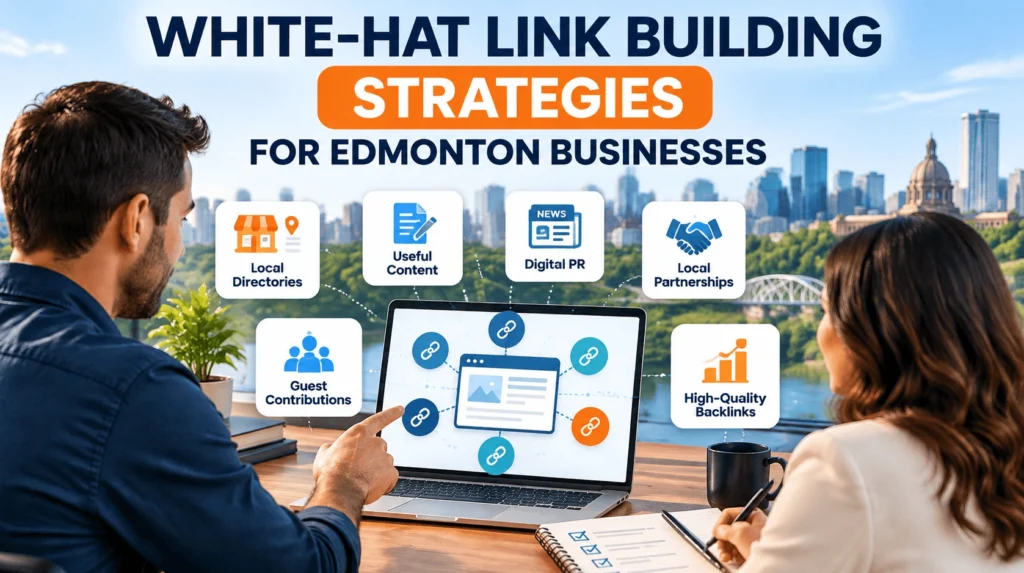
White-Hat Link Building Strategies for Edmonton Businesses
For a small business, a strong website is only part of the job. Customers also need ways to discover it, and search engines need signals that help them understand which pages are useful and relevant. White-hat link building is the process of earning links from other websites through useful content, genuine relationships, and legitimate editorial recognition rather than tactics designed to manipulate rankings.
A relevant backlink can help people find your business, give readers a useful next step, and help search engines discover and understand your content. For Edmonton businesses, a link from a relevant local resource or industry publication may be more useful than a link from an unrelated website with impressive-looking metrics. No single backlink guarantees better rankings, however. Link building works best alongside helpful content, a technically sound website, on-page SEO, and a well-maintained Google Business Profile.
This guide explains practical, ethical ways to earn backlinks, assess opportunities, measure progress, and build a manageable 30-day plan for your business.
What Is White-Hat Link Building?
White-hat link building means earning backlinks in ways that prioritise people, relevance, and editorial choice. A backlink is a link on another website that points to a page on your website. It may appear in a useful resource list, a news story, an expert article, a partner’s project summary, or a directory that helps customers find a provider.
The key distinction is the reason the link exists. An editorial link is included because the publisher believes the destination adds value for readers. A manipulative link is created primarily to influence search rankings, often through paid ranking placements, automated schemes, or excessive exchanges. Google outlines examples in its spam policies for Google Search.
For example, an Edmonton renovation company might publish a clear guide to preparing a home for winter. A neighbourhood resource, housing organisation, or journalist could choose to reference it because it answers a question their audience has. The company can promote the guide, but it cannot demand that another website link to it.
Ethical link building is not a guaranteed delivery service. The number of links earned, the time required, and any ranking changes depend on factors such as the usefulness of the resource, publisher interest, competition, and the rest of the website’s SEO. A responsible strategy focuses on creating real value and reporting honestly on what happens.
Why Edmonton Businesses Need a Local Link-Building Strategy
Build Local Relevance and Business Credibility
Local references can help people discover a business in a familiar context. A relevant link might come from a professional association, community initiative, industry resource, local publication, or organisation that has a genuine reason to mention your work. For a company serving Edmonton and nearby communities, these references can help establish connections between its services, expertise, and local audience.
Location alone does not make a website valuable. A neglected website based in Edmonton that exists mainly to sell links may be a poor opportunity. Assess the site’s audience, content, reputation, and reason for linking before spending time on outreach.
Support Local SEO and Organic Search Visibility
Backlinks are one part of a broader search strategy. Search engines also need to understand your pages, access them reliably, and match their content to relevant searches. Clear service pages, useful location information, internal links, mobile usability, and accurate business details all matter to the overall experience.
Your Google Business Profile should also be accurate and maintained. Backlinks alone do not guarantee a higher position in Google Maps or organic results. Treat link building as one supporting activity rather than a replacement for technical SEO, on-page improvements, or useful local content.
Attract Referral Traffic and Potential Customers
A backlink can send visitors directly from another website. Imagine an Edmonton property-maintenance company whose seasonal checklist is linked from a local housing resource. A homeowner may click through, read the checklist, and later enquire about a service. That referral visit has value even if it does not immediately change a search ranking.
Track referral visits and meaningful actions, such as contact-form submissions or phone calls where reliable tracking is available. A link that attracts a small number of highly relevant visitors may be more useful to the business than a link that produces no engaged traffic.
8 White-Hat Link Building Strategies for Edmonton Businesses
Choose opportunities based on relevance, credibility, audience value, and the effort required. You do not need to pursue every method at once. Start with the opportunities that make sense for your industry and resources.
1. Get Listed in Relevant Local Business Directories
Begin with legitimate directories that help customers identify suitable businesses. Depending on your industry, these may include professional associations, a chamber of commerce, trade organisations, reputable local directories, and specialist directories used by your customers.
Keep your business name, address or service-area details, phone number, and website accurate wherever those details are requested. If you operate as a service-area business, follow the directory’s rules and avoid publishing a residential address when it should remain private.
Prioritise directories with a clear purpose, real users, and reasonable listing standards. Submitting your website to hundreds of low-quality directories is not a substitute for building a credible online presence. A listing is worthwhile when it helps people find or verify your business, whether or not it passes ranking credit.
2. Build Relationships With Local Organizations
Look for genuine ways to contribute to organisations connected to your work or community. A business might provide expertise for a community project, take part in a relevant educational initiative, support an industry event, or collaborate with a complementary service provider on something useful to customers.
When an organisation publishes a recap, resource page, or project summary, it may mention contributors and link to their websites. That recognition should reflect a real contribution. Do not invent partnerships, arrange excessive reciprocal links, or make a link the condition of a relationship. The goal is to participate meaningfully; a backlink is a possible by-product.
3. Create Useful Local Guides and Resources
Publish information that answers questions customers genuinely ask. Useful resources are easier for other websites to reference than pages that only promote a service.
- Home-service provider: a practical guide to comparing quotes, checking insurance, and understanding a written estimate.
- Property maintenance company: a seasonal checklist for Edmonton homeowners, with advice that reflects local weather conditions.
- Professional service firm: a plain-language guide to documents clients should prepare before an appointment.
- Small business consultant: a worksheet for planning a realistic marketing budget.
Choose a subject that fits your actual expertise. Make the resource specific, accurate, easy to scan, and regularly reviewed. Include practical steps, definitions, illustrations, or examples where they improve understanding. Then share it with people and organisations whose audiences would benefit from it. Promotion can create opportunities, but the content must earn its place as a reference.
4. Contribute Expert Insights to Relevant Publications
Business owners often have practical knowledge that is useful to trade publications, professional blogs, community newsletters, or local business media. Pitch a clear idea tied to your expertise, such as common mistakes customers make when choosing a contractor or how a particular regulation affects your industry. Keep the pitch specific to the publication’s audience.
Read the publisher’s contribution guidelines before submitting. Provide original advice, support factual claims, disclose relevant interests, and follow any author-bio or link rules. An article should be worth publishing even if the editor chooses not to include a followed backlink. Avoid mass-produced guest posts placed on unrelated websites purely to acquire links.
5. Use Digital PR to Earn Editorial Coverage
Digital PR means developing a credible story or useful expert contribution that publishers may want to cover. A local business could offer a qualified spokesperson, explain a change affecting its industry, share a practical seasonal advisory, or help a journalist understand a complex topic.
A strong pitch makes the story clear, timely, and relevant. Provide supporting evidence, explain where the information came from, and make an expert available for questions. Do not fabricate news, exaggerate the importance of a finding, or send the same generic pitch to every newsroom. Coverage is never guaranteed, and a useful mention may not always include a link.
6. Publish Original Research and Industry Data
Original data can attract references when it answers a question that other people want to discuss. Depending on your business, you could run a properly designed customer survey, analyse anonymised service enquiries, or report on recurring questions seen by your team.
Be transparent about how the information was collected, the number and type of responses, the period covered, and the limits of the findings. Obtain necessary permission, protect personal and confidential information, and avoid presenting a small or biased sample as representative of an entire market. Charts, methodology notes, plain-language explanations, and practical takeaways make the resource easier to assess and cite.
If you do not have suitable data, plan a modest research project rather than inventing results. A clearly labelled survey of your own customers can still be useful when its scope and limitations are stated honestly.
7. Reclaim Unlinked Brand Mentions and Broken Links
Unlinked brand mentions: Sometimes a website names your business but does not link to it. If the mention is accurate and a link would help readers find the source, send a polite request. The publisher is free to decline.
Broken-link opportunities: Relevant resource pages sometimes contain links that no longer work. If you already have a page that genuinely replaces the missing resource, tell the site owner where the broken link appears and explain why your page may help. Do not suggest an unrelated page simply because you want a backlink.
A short outreach message could say:
Hi [Name], I noticed your page mentions [Business Name] but does not link to our website. If a link would be useful for your readers, the relevant page is [URL]. No problem if it does not fit your editorial guidelines. Thanks for considering it.
Keep requests relevant and respectful. Avoid repeated messages after a clear refusal or no-response pattern.
8. Develop Helpful Tools, Templates, and Checklists
Simple resources can save customers time and become useful references for other websites. Consider a website-launch checklist, a service-comparison worksheet, a local SEO checklist, a marketing budget template, or an industry-specific planning guide.
Make the resource easy to access, use, and share. Explain who it is for, how to use it, and when it was last updated. If a download collects personal information, explain what is collected and why. Share the resource with relevant publishers and professional communities where it genuinely answers a need. Do not offer hidden rewards or require a followed link in exchange for access.
How to Evaluate a Link-Building Opportunity
Before contacting a website, ask whether the link would make sense to a real reader. Use this checklist:
- Audience relevance: Does the website reach people who could benefit from your service or expertise?
- Content quality: Does it publish useful, original, maintained material rather than thin pages created at scale?
- Editorial legitimacy: Does the site have a clear purpose and make genuine editorial choices?
- Contextual relevance: Would your page naturally support the surrounding article or resource?
- Referral potential: Is there a realistic chance that interested readers will click through?
- Reader value: Would the link still help someone if it provided no SEO benefit?
- Trustworthiness: Does the website look like a legitimate publication or resource rather than a site built mainly to sell links?
| Relevant editorial opportunity | Low-quality link opportunity |
|---|---|
| The page covers a topic related to your expertise. | The website publishes unrelated topics with no clear audience. |
| An editor chooses to reference a resource because it helps readers. | The site sells followed links or promises ranking gains for a fee. |
| The website has useful content and a credible purpose. | The website is filled with thin posts, keyword-heavy anchors, and outbound links. |
| The link has a clear reader benefit. | The link exists mainly to manipulate search rankings. |
Third-party tools may show metrics such as domain authority or domain rating. These are estimates created by those providers, not official Google ranking scores. Use them as supporting clues, not as a substitute for examining the website, page, audience, and context.
Link-Building Practices Edmonton Businesses Should Avoid
Google’s link spam guidance describes practices that attempt to manipulate search rankings. Avoid tactics such as:
- Buying or selling links for the purpose of passing ranking credit.
- Using private link networks or automated services that create links at scale.
- Publishing large volumes of guest posts on unrelated websites mainly for backlinks.
- Overusing exact-match commercial anchor text, such as repeating the same money keyword in every link.
- Submitting to low-quality directories with little value for real users.
- Creating excessive link exchanges or partner pages solely to cross-link websites.
- Offering goods, services, or other incentives in exchange for followed links without applying the appropriate link qualification.
- Hiring a provider that guarantees rankings or promises a fixed number of high-quality links without explaining how they will be earned.
Advertising and sponsorship are normal business activities. The important distinction is whether a paid placement is being used to manipulate search rankings. Google recommends marking paid links with rel="sponsored"; rel="nofollow" is also an acceptable qualification in appropriate cases. See its guidance on qualifying outbound links.
Ask any prospective provider how it handles paid placements, disclosures, editorial choice, and link attributes. A transparent provider should be willing to explain the process and report the work completed without making unrealistic promises.
How to Measure Your Link-Building Results
Measure the quality and business value of the work, not only the number of links. A useful monthly review can include:
- New referring domains: Which distinct websites have linked to you, and which pages earned the links?
- Relevance and context: Are the links connected to your industry, expertise, or intended audience?
- Referral visits and conversions: Do visitors arrive from those links, and do they take meaningful actions?
- Organic search performance: Are impressions, clicks, and relevant landing-page results changing over time?
- Outreach activity: How many relevant sites were contacted, how many responded, and which resources generated interest?
Google Search Console can help you review search impressions, clicks, queries, and landing pages. Website analytics can help you understand referral sessions and conversions when tracking is configured correctly. Google explains how these tools complement one another in its guide to using Search Console and Google Analytics data.
Backlink tools may report different totals because they crawl the web differently and update their databases at different times. Keep a record of important new links and compare trends over a consistent period. Do not attribute every ranking or traffic change to link building alone; website updates, seasonality, competitors, search demand, and other SEO work can also affect performance.
A Practical 30-Day Link-Building Plan for an Edmonton Business
This four-week plan is a manageable starting point for a small team. It provides structure, not a promise of a particular number of backlinks or ranking improvements.
Week 1: Audit and Prioritize
- Review the links you already have using an available backlink tool.
- Check for relevant local directories, associations, publications, and industry resources.
- Review competing businesses for ideas, then assess each opportunity independently rather than copying every link.
- Choose one useful page or resource to improve and promote.
Prioritise opportunities that are relevant and achievable. Fix basic website issues that would make a visitor experience poor before sending more people to the site.
Week 2: Build the Linkable Asset
- Publish or improve one guide, checklist, template, or evidence-based resource.
- Check facts, explain specialist terms, and make the content easy to scan.
- Add relevant internal links so readers can find related services and guidance.
- Make sure the page works on mobile and can be accessed without unnecessary friction.
The resource should solve a real problem. Do not create a thin page just to have something to pitch.
Week 3: Research and Outreach
- Build a short prospect list of websites that serve a relevant audience.
- Read each target page and identify a specific reason your resource may help its readers.
- Write individual messages that explain the fit clearly and politely.
- Track the contact, date, resource pitched, and response in a simple spreadsheet.
A smaller, well-researched list is often more manageable than a large batch of generic emails. Avoid misleading subject lines and respect requests not to be contacted again.
Week 4: Follow Up and Evaluate
- Send one courteous follow-up where appropriate, then move on if there is no response.
- Record published links and check that they lead to the intended page.
- Review referral visits and relevant search performance, keeping other changes in mind.
- Note which topics and pitches attracted interest and use those lessons in the next cycle.
Some opportunities take longer than a month, and some will not lead to a link. Use the month to establish a repeatable process and improve it with evidence.
When Should You Hire a Link-Building or Off-Page SEO Specialist?
Professional support may be useful if your team has limited time for research and outreach, you operate in a competitive market, or you are unsure how to evaluate link quality. A specialist should help you make better decisions, not simply deliver a spreadsheet of links.
Before choosing a provider, ask:
- How do you find websites that are relevant to my business and audience?
- Which link-building methods do you use, and which do you refuse to use?
- How do you handle paid placements, sponsorships, and link disclosures?
- Will I receive transparent reporting with live URLs and the work completed?
- How do you evaluate editorial legitimacy, context, and referral potential?
- Do you guarantee a number of links or search rankings? If so, what exactly is being guaranteed?
- How will link building fit with technical SEO, useful content, on-page optimization, and local SEO?
Look for clear explanations, realistic expectations, and methods that would make sense even without a ranking benefit. RankUpFaster provides off-page SEO services in Edmonton that include backlink acquisition, local citations, directory work, competitor link analysis, and brand-mention opportunities. Review the service details and ask how a proposed approach would fit your business before committing.
Frequently Asked Questions
How can a small business earn backlinks?
Start with accurate, relevant business listings and create a useful resource that answers customer questions. Then build genuine relationships, contribute expert insight where appropriate, and contact relevant publishers with a clear reason your resource may help their readers.
Are local business directory links still useful?
They can be useful when the directory is legitimate, relevant, and helps people discover or verify your business. A listing on a low-quality directory created mainly to sell links is unlikely to offer the same value.
How long does link building take to show results?
There is no reliable universal timeline. Outreach response, publication schedules, crawling, competition, and the rest of your SEO work all affect when changes may become visible. Track progress over time rather than expecting a fixed result by a specific date.
Are paid backlinks safe for SEO?
Buying links to manipulate ranking credit can violate Google’s spam policies. Legitimate advertising and sponsorships are different, but paid links should be qualified appropriately, such as with rel="sponsored", in line with Google’s guidance.
How many backlinks does a local business need?
There is no universal target. The right opportunity depends on your market, competitors, website, and goals. Focus on earning relevant, credible links that serve a purpose instead of chasing a specific count.
Conclusion: Build Backlinks by Creating Real Value
Effective white-hat link building is based on relevance, useful resources, genuine relationships, credible editorial references, and respectful outreach. Edmonton businesses can begin with a few well-matched directories or organisations, improve one valuable page, and build a consistent process for sharing it with the right audience.
Keep link building connected to the wider SEO plan. A useful backlink cannot compensate for an unclear service page, a difficult website, or inaccurate business information. Review performance regularly, learn from the opportunities that work, and avoid anyone promising guaranteed rankings or effortless authority.
Want to strengthen your website’s authority with a sustainable approach? Explore RankUpFaster’s off-page SEO services to review options relevant to your business and target market.